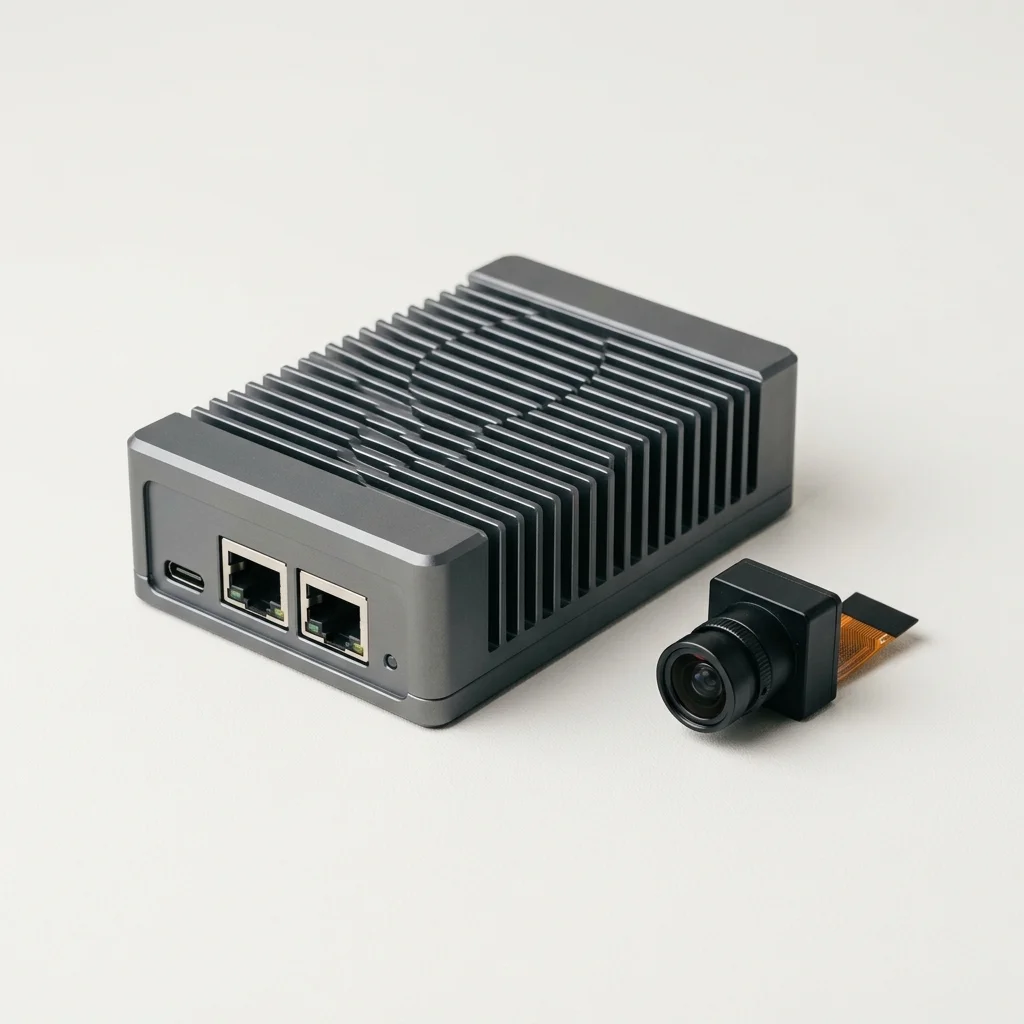
Benchmark a complete camera-to-decision pipeline, qualify the production enclosure and contract for software support across the OEM service life.
Decide where the inference runs
On the NVIDIA Jetson Orin Nano Super Developer Kit, the OEM controls a host pipeline that can ingest frames, preprocess them, run an engine and make a decision. That flexibility suits a team that expects its camera or model to change. Include image decoding, resizing and output handling in the benchmark. Timing inference alone misses work that can fill a queue before an alarm ever leaves the box.
The Raspberry Pi AI Camera places a compatible network on its Sony IMX500 sensor. Test exactly which metadata and frames the host receives in the chosen mode. The original Raspberry Pi AI Kit instead attaches a Hailo-8L accelerator to a Pi 5 host. It is a candidate for maintaining an installed base. The manufacturer has ended production. Separate service stock from the production forecast. Raspberry Pi AI Kit lifecycle
Make the model conversion repeatable
Freeze a reference model, a set of authorized test images and the expected decision for each scene. Record camera exposure settings and include empty scenes, partial objects, glare and motion blur. Identify which errors send a person to inspect the line and which could let a defective part through. Agree the acceptance threshold with the process owner before the engineering team tunes the candidate.
For an NVIDIA path, export the model to ONNX, record its operator set and build the TensorRT engine for the intended target software stack. Check unsupported operators, precision changes and output differences against the reference. For the sensor and Hailo paths, use their respective conversion tools and verify supported layers and memory limits. Keep the conversion recipe, calibration inputs where needed and compiler versions with the release. TensorRT prerequisites
Run a timed sequence long enough to expose dropped frames and queue growth. Measure from frame acquisition to the decision reaching the receiving controller. Report the tail of the latency distribution along with the median and missed decisions. A model that keeps up on average can still miss a moving part when storage writes, diagnostic capture and inference coincide.
Qualify the thermal and power envelope
Use the proposed enclosure, mounting orientation, cable lengths and cooling arrangement. Measure ambient temperature at the inlet, processor temperature, operating clocks and throughput together. Repeat after temperatures stabilize, then restart the unit warm. If the prototype depends on a fan, include filter changes, access clearance and the alert that tells maintenance the airflow has degraded. Save the full run trace with the sample serial.
For Power over Ethernet (PoE), identify the powered device, splitter or converter, supported class, conversion losses and switch budget when all ports are occupied. For DC input, check the voltage at the board during startup with the camera and storage connected. Include the heater or illuminator if the production camera needs one. Stage a simultaneous restart of the proposed switch load and record which nodes return without operator intervention.
Keep a spare production unit at the integrator's bench. After a power test, swap it for the installed sample using the customer's recovery instructions. Check lens calibration, network identity and the destination of outgoing events. A spare that still points to the bench controller can appear healthy to maintenance while the production line receives no decisions.
Assign data protection and lifecycle ownership
For EU deployments, map images, detections, diagnostic clips and remote support access. Local inference can still process identifiable people. Have the controller document its GDPR lawful basis, retention policy, access rights and any need for a data protection impact assessment. Set the default diagnostic mode on a fresh unit and verify deletion using a synthetic clip. Record whether support can export that clip and who authorizes access. European Commission data protection obligations
Request separate lifecycle statements for the system on chip (SoC), production module, carrier, camera and operating system. A developer kit can disappear while modules remain available. Agree change notification, last-order notice and how to requalify a replacement sensor. For an EU product within Cyber Resilience Act (CRA) scope, name the party that maintains the software inventory, receives vulnerability notices and delivers fixes after handover. Commission CRA implementation timeline
Pre-deposit verification checklist
Freeze the production bill of materials, enclosure and lens. Obtain dated availability statements and a replacement plan for any development-only component used in the pilot.
Archive the reference decisions, conversion recipe and thermal run. Demonstrate that a second engineer can rebuild the deployable artifact and reproduce the sample result.
Approve the PoE port or DC supply schedule with peripherals attached. Witness a warm restart and budget the service visit if a node fails to return.
Have privacy and support owners sign the data-flow diagram, diagnostic retention period and update agreement. Test installation of an authorized update and the documented recovery procedure on a spare.
Frequently Asked Questions
Can the buyer rank these platforms by advertised TOPS?
Use the actual model and acceptance dataset. Precision, supported operators and time spent moving frames change the usable throughput. Report missed decisions, detection quality and power at the same camera rate across candidates.
Is an on-sensor model sufficient to keep all images private?
Inspect what the host receives and stores in normal and diagnostic modes. Check support exports and retained clips. Configure access and retention around the complete pipeline, including downstream records that can identify people.
What should the OEM retain when the integrator hands over the project?
Retain the approved model, deployable artifact, rebuild instructions, component revisions and target software image. Name a maintainer with access to the release tools and require an independent rebuild before signing acceptance.
Export a structured pre-PO procurement checklist extracted from this playbook's verification sections, buyer diligence questions, and referenced catalog SKUs.
An 8 GB Orin Nano module and reference carrier board let developers benchmark local vision and language models. NVIDIA rates the kit at up to 67 sparse INT8 TOPS in Super mode.
A 12.3-megapixel Sony IMX500 runs a compatible neural network on the image sensor. The Raspberry Pi host can read inference results alongside frames through its camera software.
This original Pi 5 kit combines an M.2 HAT+ and a removable 13 TOPS Hailo-8L inference module. Raspberry Pi has ended production and retains the documentation for existing installations.