RoboticsDocs under review
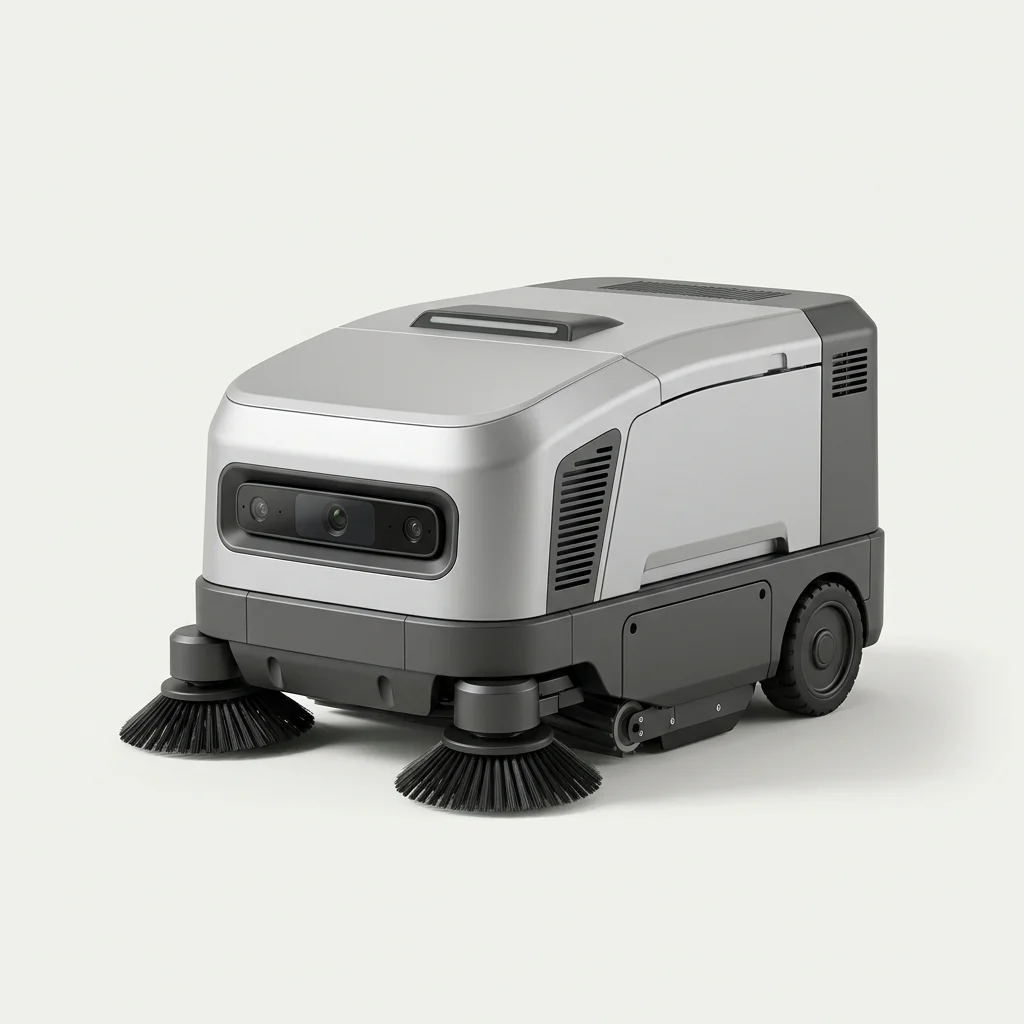
PUDU Robotics MT1
MT1
Vision-guided debris detection directs a pair of sweeping brushes toward litter. The 35 L bin suits long dry aisles.
- Commercial floor care
Buying guide · 6 min · Updated 2026-11-22
Walk the route after the busiest interval. Mark loose packaging, grit in entrance matting, dried drink spills and corners inaccessible to a machine. Record which tasks the existing team performs before opening and which can happen among occupants. A sweeper that removes visible litter may complete an entire route while leaving the contract's sticky-soil requirement untouched. Give bidders the same floor plan and acceptance photographs so that each proposes a machine for the same work.
| Candidate | Documented cleaning method | Operational question |
|---|---|---|
| PUDU MT1 | Vision-guided sweeping with a 35 L bin | Can the operator reach the unloading point during deliveries? |
| KEENON KLEENBOT C30 | Dry sweeping, vacuuming and dust-mopping across up to 610 mm | Who treats adhered spills after the dry pass? |
| Karcher KIRA B 50 | Roller pre-sweep and wet scrub with an optional service dock | Where can clean water enter and recovered water drain? |
| SoftBank Whiz i | Follows taught dry vacuum routes | How often does the furniture layout change? |
| Makita DRC300Z | Tool-only vacuum using one or two 18 V LXT packs | Which shift owns pack changes and external charging? |
| LionsBot R3 Vac | Vacuum with a 350 mm main cleaning path and side brush | Can the chassis turn between occupied tables? |
The C30 deserves particular attention when tender documents use “scrubber” as a category label. KEENON describes dry work. Ask the bidder to name the separate wet process and include its labor in the same offer. For the KIRA, establish whether the proposed price includes the optional dock. Have the facilities engineer survey its service connections and the space the machine needs to approach. KEENON C30 specifications Karcher KIRA B 50
Set the denominator before talking about fleet size. Mark each required zone on a plan and count its area once when the supervisor accepts it to the contract standard. Include the cost of repeat passes and manual finishing in the numerator. Report inaccessible zones separately. Where overnight and daytime specifications differ, keep the two measures separate so that an easy daytime litter pass cannot mask an unfinished overnight scrub.
For example, if a trial covers 900 square metres but the supervisor initially accepts only 720, record 720 accepted square metres for that inspection. Log the worker minutes and consumables used to recover the remaining 180. If those areas subsequently pass, add them once. Use unique zone identifiers for overlaps. This example describes a counting method a supervisor can audit against the plan.
For total cost of ownership (TCO), annualize acquisition and dock works over the evaluation period agreed with finance. Add service, batteries, brushes, filters, water, energy, software and operator hours including setup and rescues. Divide by accepted area over the same period. Show a second scenario with a dock or robot unavailable during the busiest shift. Credit redeployed labor only when a named task can actually leave the roster. Someone responsible for a nearby spill may have to remain on duty while the robot runs.
Have the site safety lead approve a supervised trial with a trained operator and a clear recovery procedure. Map blind corners, automatic doors, lift lobbies, ramps and temporary obstructions. Begin in a controlled area with representative objects and the manufacturer's prescribed checks. Confirm how staff stop the machine and prevent an unintended restart. Record who releases a route after a plan change or a near miss. Move into normal traffic only after site approval.
For indoor automatic floor treatment, ask the assessment body how IEC 63327 applies alongside the relevant IEC 60335 parts, including part 2-72 and, for pickup-only machines where specified, part 2-69. Request scope, edition, exact machine revision and operating modes in the report. ISO 13482 concerns personal care robots. A reference to it alone leaves the facility's commercial floor-cleaning application unresolved. IEC commercial floor treatment scope ISO personal care robot scope
On wet routes, arrange signs, inspect recovered water and measure when a pedestrian can safely use the floor under the site's procedure. For fleet scheduling, reserve both dock time and approach space. Observe two machines needing service during the same interval. Write down who can move an obstruction, put a unit into manual recovery and verify that a partially completed zone gets cleaned before shift change.
Verify each mains charger for the actual building circuit, such as 120 V, 60 Hz in North America or 230 V, 50 Hz in the UK. Specify electrical safety evidence acceptable to the facility and the applicable FCC or ISED records for wireless equipment. Get the exact charger revision, plug, circuit demand and any dock water works signed off before scheduling installation. A robot pack voltage describes a different part of the system from the wall supply.
Match the battery label and UN 38.3 test summary to the replacement pack. Standalone lithium-ion packs generally travel as UN3480, while lithium-ion packs packed with or contained in qualifying equipment generally use UN3481. Have the dangerous-goods specialist classify the whole machine and each spare shipment for the chosen mode. Confirm volume FOB and MOQ via written RFQ, identifying the named port, dock options, regional spares, local response time and the cost of a replacement unit during repair. IATA battery guidance
Specify two acceptance tests. A dry vacuum can address loose material on compatible carpet, while adhered soil can require wet treatment and recovery on a suitable hard floor. Require the bidder to identify who completes each task on the shift plan.
Use accepted area per available shift from the site trial. Subtract charging, blocked routes and servicing from available time. Size the fleet against the busiest repeatable shift and check that the planned operators and docks can support that many concurrent routes.
The operator still has to manage removable packs and external charging. Time the round trip to the charging location, label the packs by condition and agree who has a charged replacement ready when the next route begins.
Keep the dated route revision, start and finish times, missed zones, inspection results and intervention log together. Record how a supervisor can retrieve the evidence if the cloud dashboard is unavailable. Agree how long the facility may retain maps and who can access them.
Examine which failure in the pilot stopped an entire shift and how long a replacement takes to arrive. A worn pickup component may be easy for onsite staff to replace, while a disabled shared dock may affect several routes. Price both recovery plans.
Free B2B Procurement Export · Playbook Checklist
Export a structured pre-PO procurement checklist extracted from this playbook's verification sections, buyer diligence questions, and referenced catalog SKUs.
MT1
Vision-guided debris detection directs a pair of sweeping brushes toward litter. The 35 L bin suits long dry aisles.
KLEENBOT C30
The C30 dry-sweeps, vacuums and dust-mops with a cleaning span of up to 610 mm. An extendable handle supports manual mapping.
KIRA B 50
A roller head pre-sweeps and scrubs hard floors. The optional service dock fills fresh water, drains recovered water and charges the machine.
Whiz i
The BrainOS-based commercial vacuum follows taught dry-cleaning routes across carpet and hard floor.
DRC300Z
This tool-only LiDAR mapping vacuum accepts one or two 18 V LXT packs. It can return to its starting point after a dry route.
R3 Vac
A 350 mm main cleaning path reaches between furnishings on carpet and hard floor. A side brush extends coverage along walls.